WHAT IT IS
This is the free playable beta. An expanded Cinderlift edition is in development for Steam.
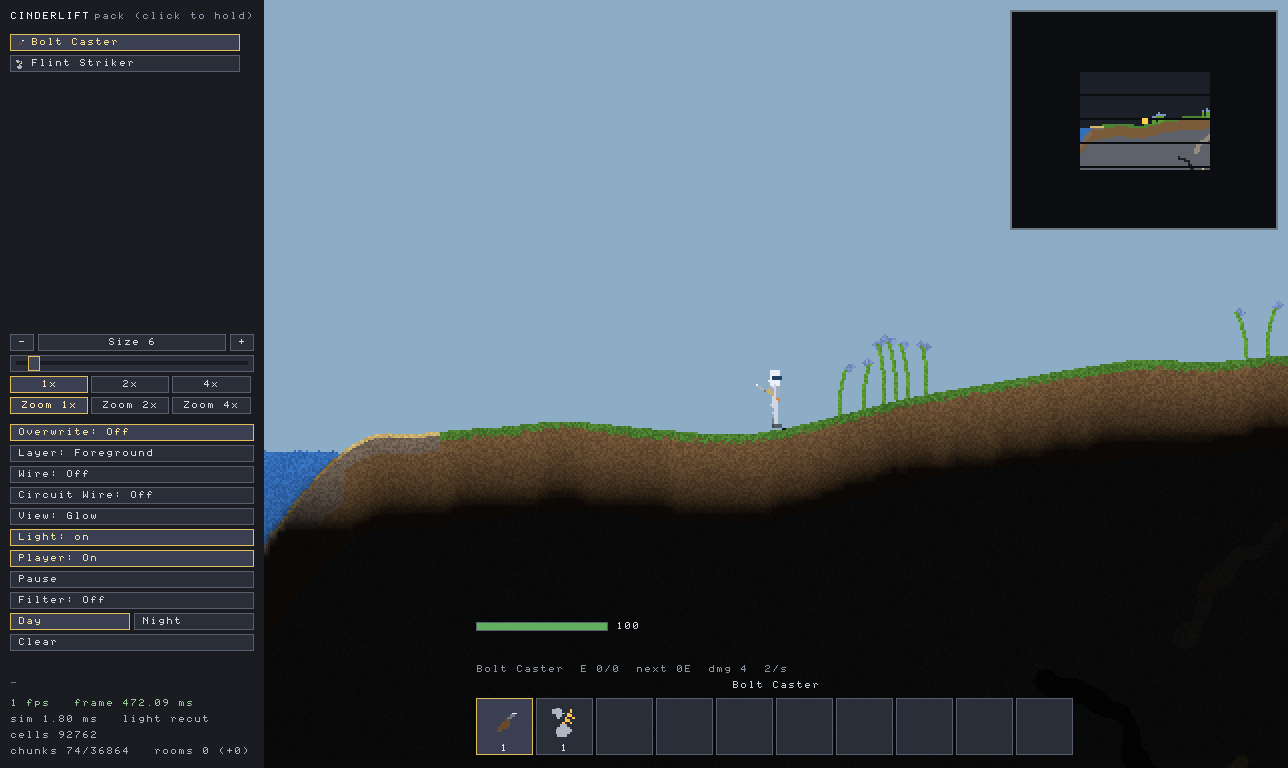
Cinderlift is a falling-sand sandbox where the physics is the game. Every cell in the world carries a material, a temperature and a moisture level, and it is simulated rather than scripted — sand falls, water finds its level, heat conducts through whatever is touching whatever, and things melt when they get hot enough and freeze again when they cool.
You crashed on a planet. Everything below you is rock, ore and the caves between them, and the way out is up — which means digging, smelting, wiring and building your way there.
NEW HERE? START WITH THE GUIDE
The game does not explain itself much, and a few of the things that matter most are never mentioned at all. The guide is fifteen short tutorials, in order, each one assuming only the ones before it — and every one ends with a list of the ways it goes wrong, because that is the half you cannot work out alone.
And a reference for everything else
The rest of the wiki is generated from the game’s own code, so it cannot disagree with it: every material with its melting and ignition points, every item, every recipe in both directions — what a thing is made of and what it is for — every creature and every machine, including where each one stops.
HEAT IS REAL, AND IT IS THE POINT
Most sandbox games treat fire as a state a tile is in. Here temperature is a number every cell has, conducted between neighbours at a rate the two materials decide, and almost everything interesting is a consequence of that rather than a rule written for the occasion.
- Metals melt and re-freeze. Iron and copper have melting points; molten metal cools back into the solid it came from.
- Water boils where it touches something hot enough, and the steam goes where steam goes.
- Rubber is the best insulator in the game — and it melts at exactly water's boiling point, so it works beautifully right up until you ask it to do anything genuinely hot.
- Graphene has no melting point at all. It is what you line a crucible with when nothing else will survive.
- Acid corrodes, and it pools in the second layer where you will be standing.
WIRES, LOGIC AND MACHINES
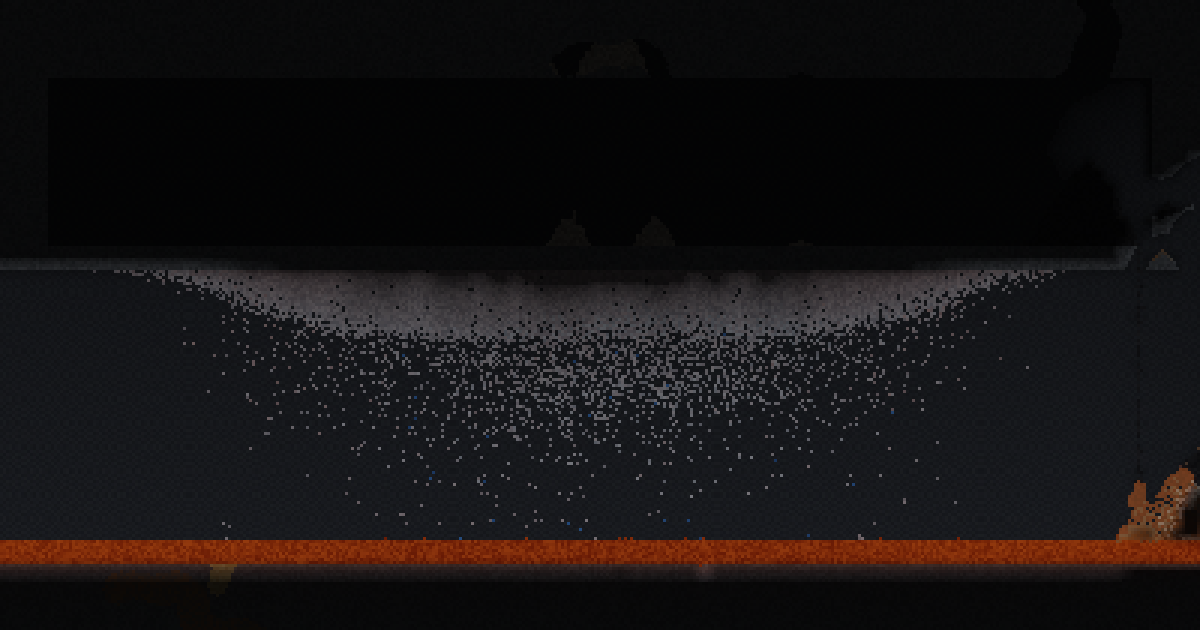
Copper conducts. A pulse travels along it as an actual moving thing, splits at junctions, fills a thick wire once rather than flooding back down its own trail, and two waves sent at each other meet and stop.
On top of that there are sensors and actuators: thermocouples that read temperature, clocks, pulse buttons, block watchers, combinators for logic, placers, miners, spouts and drains. Enough to build a furnace that regulates itself, or a pump that runs when a tank is low, or something considerably more ambitious.
THREE LAYERS DOWN
The world is 4096 cells wide and 9216 deep, generated fresh each time, and cut into layers by strata you cannot dig through until you have earned the tools.
- Layer 1 — copper, tin, coal, iron. Warm brown rock. Where you learn the game.
- Layer 2 — gold and titanium, and acid pockets. Cold green. The difficulty step.
- Layer 3 — tungsten, and lava hotspots. Hot red. The deep.
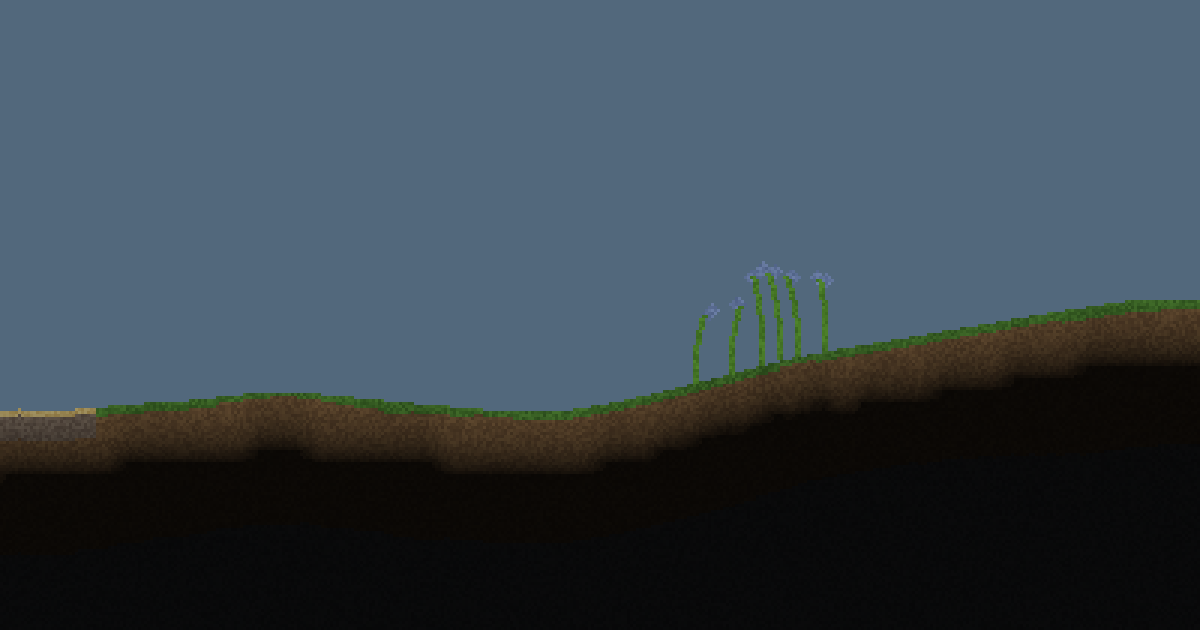
Day and night pass overhead, light propagates properly from the sun and from whatever you are carrying, and it gets very dark down there.
PLAY IT
In your browser, free, right now — scroll back up. Nothing to install, about 1.5 MB, and it runs on any desktop browser.
Both versions keep ten save slots and both support four-player multiplayer. They connect differently: in the browser the host shares one six-character code, and the Windows download connects by IP address, which is steadier on awkward networks. Windows also keeps its saves as ordinary files you can move between machines. It is the same game and the same code — the browser build is that code compiled to WebAssembly rather than a cut-down port.
QUESTIONS
Is it “Cinderlift” or “Cinder Lift”?
One word: Cinderlift. Plenty of people type it as two, so if you searched for cinder lift and ended up here, you are in the right place — it is the same game either way.
How do I learn to play?
Start with your first ten minutes and follow the guide in order. When you want to look one thing up — what melts copper, what a creature drops, what you can build with what you have — the wiki has a page for it, and search finds it by name.
Does the browser version save my world?
Yes — the same ten slots as the Windows build, kept in your browser's own storage, so they survive closing the tab and restarting your computer.
Two things worth knowing, because they are the ways it can bite you. The saves live in this browser on this device: they will not follow you to another computer, or even to a different browser on the same one. And because they are site data, clearing your browsing data will delete them, as will playing in a private window. If a world matters to you, the Windows build keeps its saves as ordinary files instead.
How does multiplayer work in the browser?
Press Multiplayer under the game and pick Host. You get a code
like RZ7ZT. Share it with up to three friends; they each press
Multiplayer, pick Join, and type in the same code. That is the whole thing.
Once connected, every guest browser talks straight to the host. Nothing sits in the middle of your game — there is no server carrying it, which is why this costs nothing to run and why nobody else can read it. The code is handled by a tiny service that introduces each guest to the host and then plays no further part; if it is ever down, the panel falls back to exchanging longer codes with each guest by hand, which needs nothing at all.
If somebody's connection drops, they rejoin on their own and come back as the same player — you do not need to share the code again.
Two things can go wrong. Everyone needs the same version — refresh the page if anyone has had it open a while. And some strict networks will not allow a direct connection at all; there is no relay to fall back on, so if it will not connect, the Windows build can host by IP instead.
Windows says the download is unrecognised.
The executables are not code-signed yet, and Windows warns about anything it has not seen before from a publisher it cannot verify. The launcher is the more suspicious of the two by nature, because updating itself looks exactly like what malware does. Everything is open source — the repository is right there, and every release publishes SHA-256 hashes for both binaries.
What are the system requirements?
A desktop browser, and roughly 350 MB of memory for the world. Phones generally cannot spare that. It runs comfortably on old laptops otherwise.
Is it finished?
No, and it is being worked on steadily. Watch the releases if you want to follow along.